

The quick answer
Most exterior defects trace back to water. It comes off the roof and lands in the wrong place, it runs toward the house along sloping soil, it slips into a cracked masonry wall or it sits on a flat surface that never drains. Metro Atlanta gets close to 50 inches of rain in a typical year, and much of it falls on red clay that drains slowly, so small exterior defects turn into expensive ones faster here than in drier parts of the country.
On every inspection we walk the outside of the building and read it for water: the gutters and downspouts, the ground around the foundation, the brick and siding, and any flat roof or paved area that holds water. Here is what we look for and what each sign usually means.
Gutters and downspouts
Gutters exist to collect roof water and carry it away from the building. They fail in familiar ways. Sections sag so water pools instead of draining, seams open and drip onto the fascia, hangers pull loose, and tall pines and oaks fill the channel with needles and leaves until it overflows down the wall. Stains on the siding below a gutter and soft, dark fascia board behind it are the signs we look for first.
The downspout matters just as much as the gutter. Water that comes out right at the foundation soaks the soil beside the wall, so downspouts should discharge several feet away, commonly 4 to 6 feet or more, onto ground that slopes away from the building. We check that extensions and splash blocks are in place, that buried drain pipes aren't crushed or clogged, and that no downspout empties onto a walkway or driveway where water will pool or freeze. Drone photos help us see gutters and roof edges that are hard to judge from the ground.
Grading and soil
The ground around a building should fall away from the foundation. A widely used building code guideline is a drop of about 6 inches in the first 10 feet. Over the years soil settles, flower beds get built up against the siding, mulch piles against the wall and walkways tilt the wrong way, and the slope quietly reverses. Water then collects against the foundation, where it can reach a crawlspace or basement.
Red clay makes this more serious. It swells when it is wet and shrinks as it dries, and that cycle can push on foundation walls and open cracks. If you see soil that slopes toward the house, mulch touching the siding or bare patches where water flows, those are fixes worth making before the next heavy storm. Moisture that does make its way inside is a leading cause of the musty crawlspaces we cover in our mold inspection guide.
Brick and masonry cracks
Brick veneer is common across metro Atlanta, and nearly every brick building has some cracking. What matters is the pattern. The location, the direction and the width tell us whether a crack is cosmetic or a sign that the wall is moving, and whether water is getting in behind it.
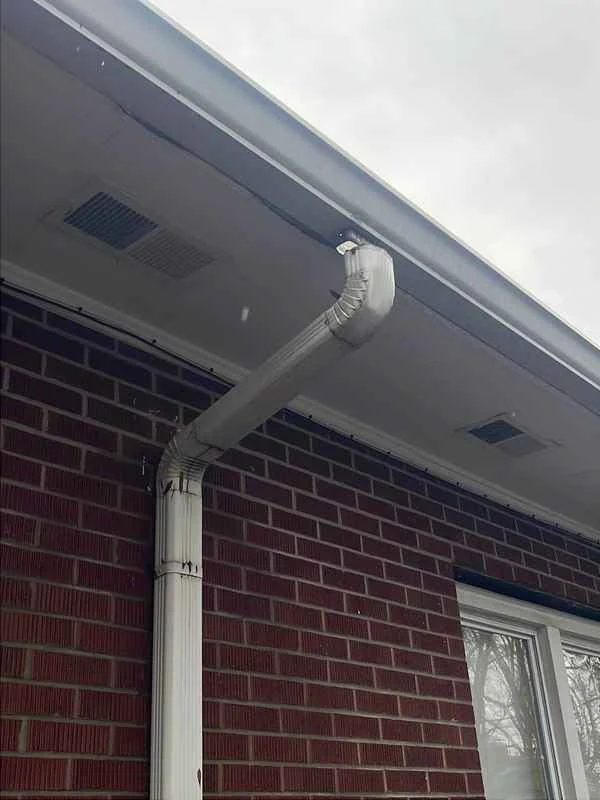
| What we see | What it often means | What to do |
|---|---|---|
| Hairline crack in a mortar joint, under about one-eighth inch | Normal shrinkage or minor settling | Seal it, photograph it and watch it |
| Stair-step crack that follows the mortar joints | Differential movement in the foundation | Mark it, monitor it and call an engineer if it grows |
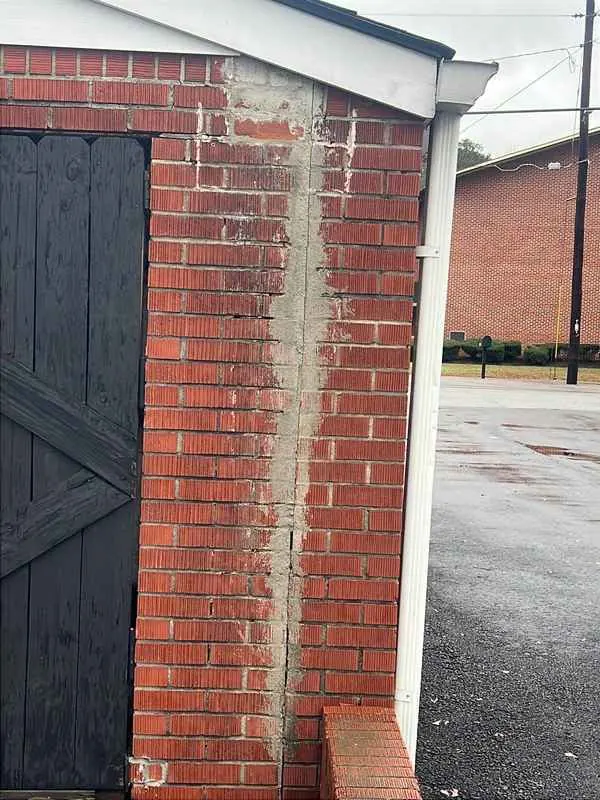
| Vertical crack at a corner or beside a door or window | Thermal movement, a missing control joint or lintel movement | Check for water entry, patch it and monitor |
| Horizontal crack along a course of brick | Soil pressure or a rusting steel lintel | Have a structural engineer evaluate it |
| Wider than about a quarter inch, or doors and windows that stick | Active movement | Structural engineer |
A crack that has been patched with mortar and opens again, like the corner crack in the second photo above, is telling you the wall is still moving. We also check the weep holes along the bottom course, which let water escape from behind the brick and should stay open, plus the flashing above openings and the sealant around windows and doors. These small details decide whether water that gets behind the brick can get back out.
Siding, trim and sealant
Water that gets past the surface of a wall rarely stays visible. Wood trim, fiber cement and vinyl siding all depend on caulk and flashing to shed water at the joints, and in Georgia heat that caulk dries, shrinks and pulls away faster than most owners expect. We check around windows and doors, at corners and trim boards, where pipes and wires pass through the wall, and at the bottom edge of siding where it meets the ground or a deck.
- Soft or swollen trim near the ground or under a window usually means water has been getting in for a while.
- Gaps in caulk around windows, door frames and penetrations let water in and let air out.
- Siding that touches soil or mulch wicks moisture and invites termites, so it should clear the ground.
- Rust streaks under a window or lintel point to flashing that has failed or steel that is corroding.
- Hose bibs and exterior outlets need sealed edges, since a loose fitting sends water straight into the wall.
We tap and probe suspect trim, use a moisture meter where it helps and scan walls with infrared, because damp framing behind siding can look perfectly normal from the street. Finding the source early is the difference between a caulk repair and a rotted wall section.
Ponding on roofs and pavement
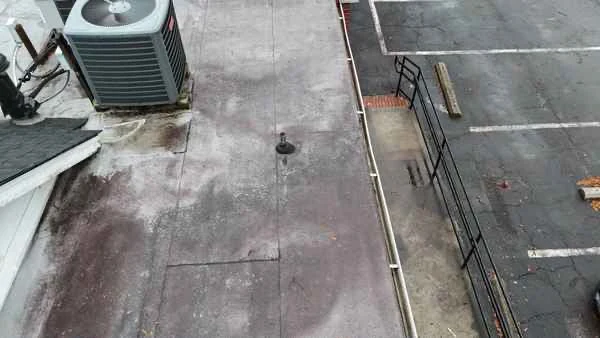
Flat and low-slope surfaces are built to drain, and when they don't, water sits. On a low-slope roof the roofing industry commonly treats water that is still standing about 48 hours after a rain as ponding. It speeds up wear on the membrane, finds every weak seam and shows up as staining like the dark patches in the photo below. Rooftop equipment adds penetrations, and each one is another place for water to get in.
The same idea applies to pavement. Standing water at the edge of a parking lot, as in the photo below, usually means a grading or drainage problem. It undermines the pavement, creates slip hazards and, when it collects at accessible parking spaces and routes, becomes something the owner should fix. A home inspection doesn't replace a code or accessibility review, but we flag what we see so it gets looked at.
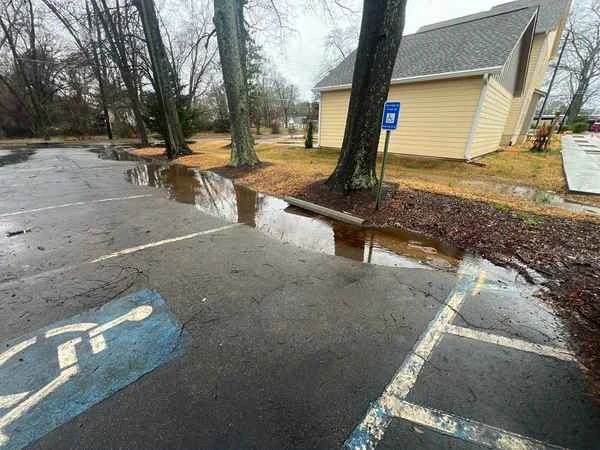
These are common findings on the commercial properties we inspect, and our guide to what a commercial inspection includes covers the rest of the building.
Signs water is already getting inside
Exterior water problems often announce themselves indoors first. Watch for a musty smell in the crawlspace or garage, white mineral deposits on a foundation wall, doors and windows that suddenly stick, baseboards that swell or lift, and stains on a ceiling or at the bottom of an exterior wall. Any of these can come from a gutter that overflows, a downspout that dumps at the wall or a crack that lets water through. They are worth tracing to the source before you paint over them, since a stain that comes back after painting is a leak that is still active.
A simple seasonal routine
- Clean the gutters after the leaves fall and again in spring, and more often if pines overhang the roof.
- Walk the perimeter after a heavy storm and look for water standing near the foundation and for downspouts that are running over.
- Check the grade each year, and pull mulch and soil back from the siding.
- Look at the brick once or twice a year and photograph any crack you are watching.
- Keep the weep holes and vents clear of dirt, mulch and paint.
When to call a professional
Cleaning a gutter or extending a downspout is a homeowner job. Call an inspector when you see stains running down a wall, soil sloping toward the foundation, water in a crawlspace, or brick that keeps cracking. Call a structural engineer when a crack is wider than about a quarter inch, runs horizontally or comes with sticking doors and windows.
If you are buying, a full buyers home inspection covers the exterior, the grading and the roof edges in one visit, and a roof inspection adds a closer look from above. Sellers can find and fix these items first with a pre-listing inspection. We work across Cobb County and beyond, including Marietta, Peachtree Corners, Sandy Springs and Cumming. For the big picture, see the problems we find most often. Water management continues indoors, and our attic inspection checklist covers that half. Call or text (678) 558-4222 to book.