

The quick answer
You need a home inspection any time you are about to buy a home, and you should strongly consider one when your house starts showing physical warning signs: a sagging roofline, water stains, a musty smell, doors that suddenly stick, cracks that keep growing, breakers that trip or drains that gurgle. Each of those can be minor. Each can also be the first visible symptom of a bigger problem that gets more expensive every month it is ignored.
After years of inspecting homes across Marietta and the rest of metro Atlanta, I can tell you the pattern rarely changes. By the time a homeowner calls about a stain on the ceiling, the leak behind it has usually been there for a while. The goal of this guide is to help you catch those signs earlier, understand what they might mean and know when it is time to bring in a certified inspector.
Warning signs outside the house
Walk around your home slowly once or twice a year, ideally after a heavy rain. Most of the problems I document in a report show their first hints on the exterior.
A sagging or wavy roofline
A roof ridge should look straight. Dips, waves or a sway in the middle can point to deteriorated decking, undersized framing or long-term moisture in the attic. Pair that with shingles that are curling, cracked or missing, or with gutters full of shingle granules, and the roof is likely near the end of its life. Our guide to what a roof inspection includes walks through exactly how we evaluate this.
Water that drains toward the house
Georgia's red clay drains slowly. When soil slopes toward the foundation, when downspouts dump water right at the corner of the house or when gutters overflow, water ends up in crawlspaces and basements. Look for soil washing away, puddles that linger along the foundation and stains on the lower courses of siding.
Cracks in brick, block or the foundation
Hairline shrinkage cracks in concrete are common and usually cosmetic. Stair-step cracks in brick or block, horizontal cracks in a basement wall, cracks wider than about a quarter inch or cracks with one side higher than the other deserve a professional look. Doors and windows that stick at the same time are an important clue that movement is happening.
Soft trim, damaged siding and failing decks
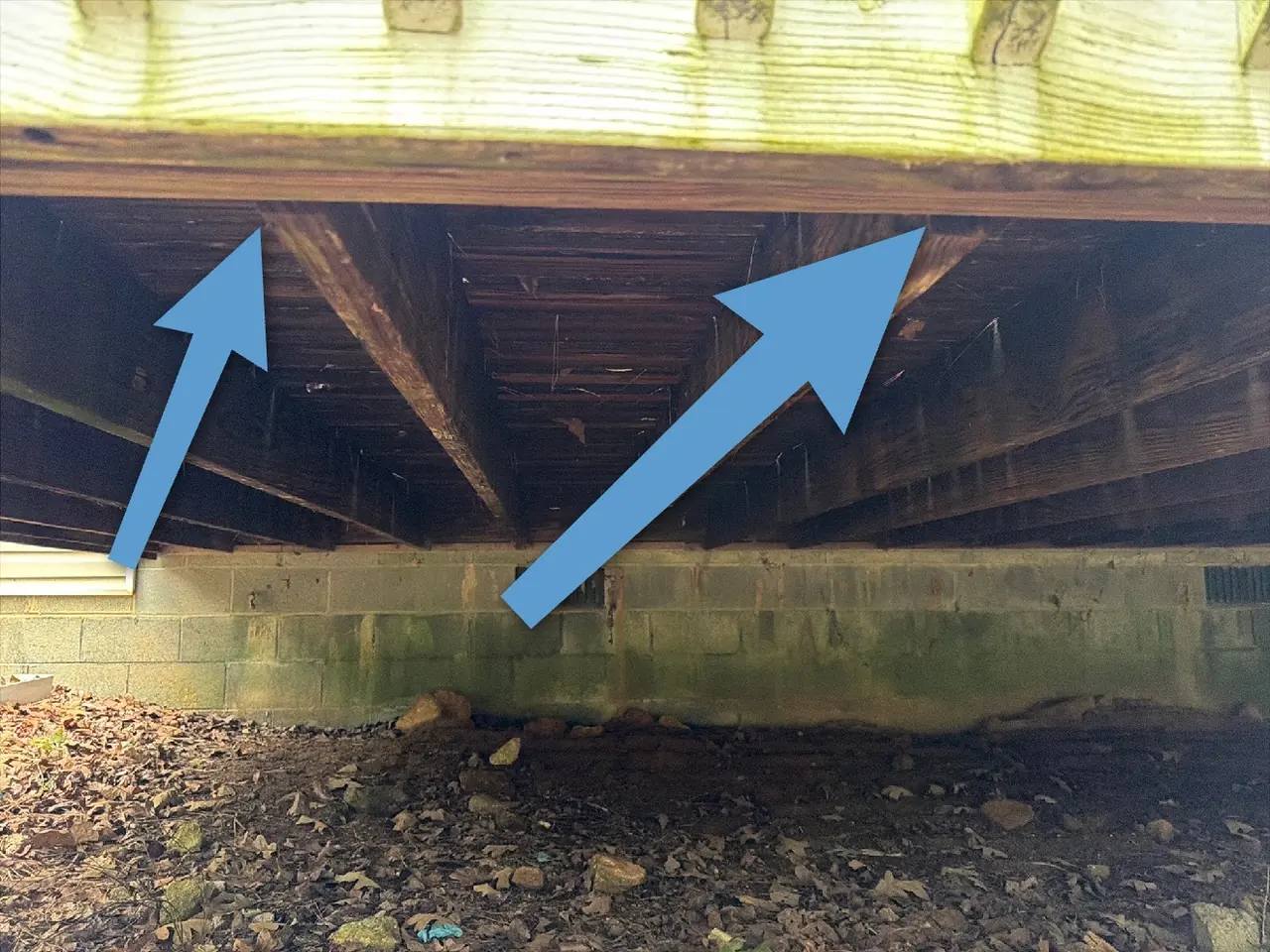
Push gently on window trim, fascia boards and the bottom edges of siding. Soft, spongy wood means rot, and rot invites carpenter ants and termites. Decks deserve special attention because they fail at the connections: the ledger board where the deck attaches to the house, the joist hangers and the post footings. The photo at the top of this article shows the kind of under-deck framing view most buyers never see.
Warning signs inside the house
Stains on ceilings and walls
A yellow or brown ring on a ceiling almost always means water reached the drywall at some point. The question is whether it is still happening. During an inspection we use an infrared camera and a moisture meter to check whether the area is wet right now, then trace the likely source, which might be a roof flashing, a bathroom above, an HVAC condensate line or a plumbing connection.
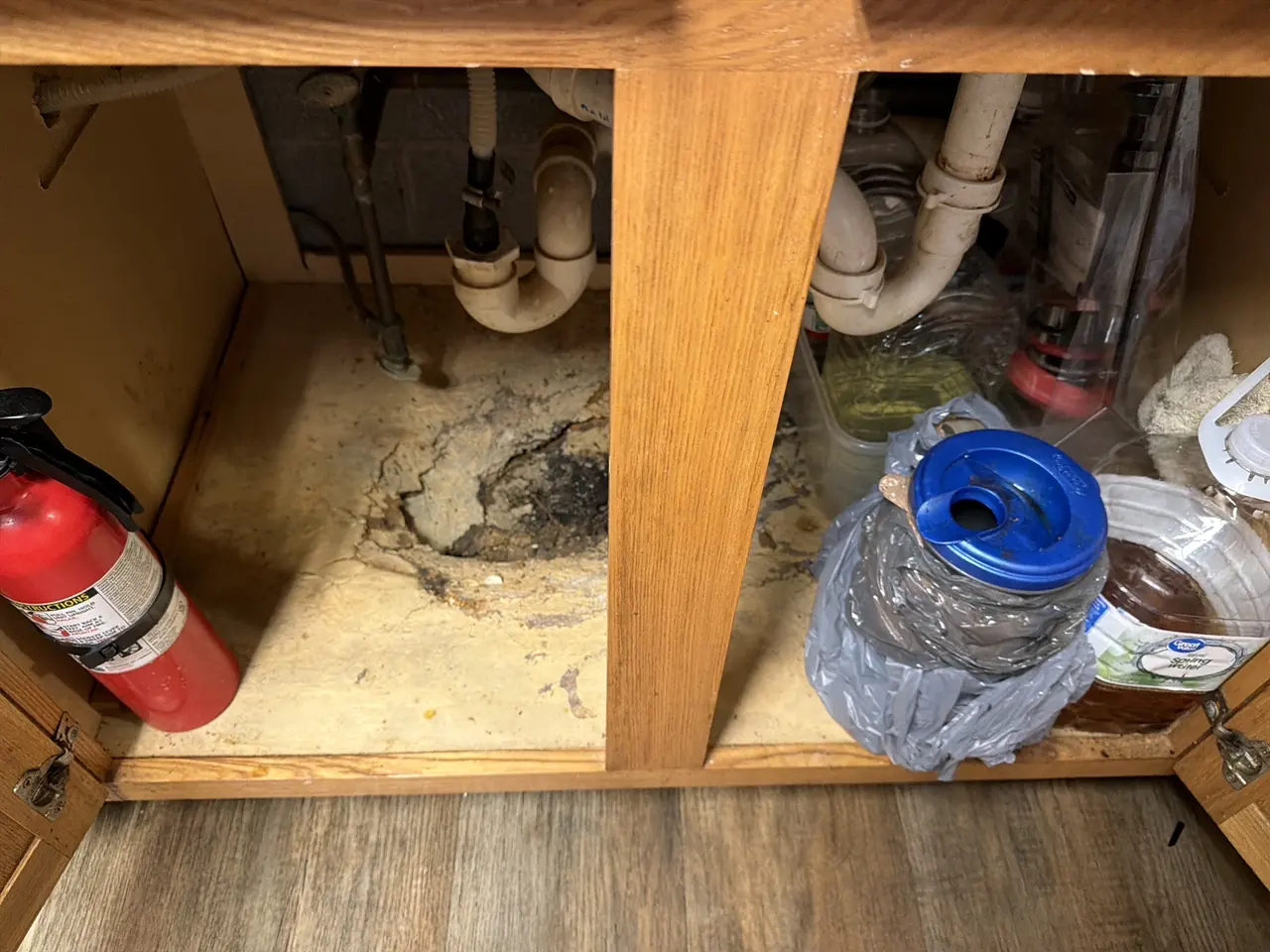
Slow leaks are the most deceptive. Damage like the rotted cabinet floor in the photo above builds up over months, usually hidden behind whatever is stored under the sink. Opening every sink cabinet and looking at the floor with a flashlight takes ten seconds and is one of the best habits a homeowner can build.
Musty odors
A persistent earthy or musty smell, especially in a basement, crawlspace, closet or bathroom, is one of the most reliable signs of hidden moisture and possible mold growth. Air fresheners hide the symptom while the problem grows. If your nose keeps telling you something is wrong, a mold inspection with moisture mapping can find the source.
Doors that stick and floors that slope
Seasonal humidity can make wooden doors swell a little. But when several doors start sticking at once, when new diagonal cracks appear above door frames or when a marble rolls across a floor that used to be level, the structure may be moving. Most of the time the cause is manageable, such as a settled pier in a crawlspace, but it should be evaluated.
Pests and droppings
Mud tubes on foundation walls, discarded wings near windows, frass that looks like sawdust and rodent droppings in the attic or under sinks all point to openings in the building and conditions that attract pests. Every full home inspection we perform includes a free termite inspection for exactly this reason.
Electrical, plumbing and HVAC red flags
These are the system symptoms I take most seriously, roughly in order of urgency:
- Warm or discolored outlets and switch plates. Heat means resistance, and resistance can mean a fire risk. Stop using the outlet and call a licensed electrician.
- Breakers that trip repeatedly. A breaker doing its job once is normal. A breaker that trips every week is telling you the circuit has a problem.
- Flickering lights on more than one circuit. This can point to a loose connection at the panel or the service entrance.
- Two-prong outlets throughout the house. Common in older Smyrna, Marietta and Sandy Springs homes, ungrounded circuits limit what you can safely plug in.
- Gurgling drains and slow drains in several fixtures. When more than one drain is slow, the main line may be partly blocked by roots or a sag. A sewer scope inspection shows the line on camera.
- Rusty or discolored water and low pressure. Common symptoms of aging galvanized steel supply pipe.
- A water heater with rust at the base or a dripping relief valve. Tanks usually last around 8 to 12 years, and failures tend to happen all at once.
- Rooms that never feel comfortable and rising energy bills. Often a sign of an aging HVAC system, leaky ductwork or poor attic insulation.
Moments that call for an inspection
Sometimes the sign isn't in the house at all. It is a moment in the life of your home:
- You are buying a home. This is the big one. A buyers home inspection during your due diligence period is the only time you can uncover problems while you still have leverage to negotiate.
- You are about to list your home. A pre-listing inspection finds problems before your buyer's inspector does.
- Your new home is approaching its first anniversary. A builder's warranty inspection around month 11 documents defects while the builder still has to fix them.
- A major storm just passed. Wind and hail damage on a roof is easy to miss from the ground and gets worse with every rain.
- You had a leak or flood. Even after visible water is cleaned up, moisture can remain in walls, subfloors and insulation.
- You are planning a renovation. Knowing the condition of the electrical, plumbing and structure first prevents expensive surprises once walls are open.
- You are buying a flipped or vacant home. Fresh paint and new floors can hide old systems and recent leaks.
What to do when you spot a sign
Start by writing down what you noticed and when, and take a photo. Then decide whether it needs a specialist or a broader look. A single clear problem, such as a dripping relief valve, can go straight to a licensed plumber. When you see several signs, or you aren't sure what a symptom means, a home inspection is the better first step because it looks at how the systems affect each other. A roof leak, a stained ceiling and a musty attic are often one problem, not three.
A full inspection of a typical metro Atlanta home takes about 2.5 to 4 hours, and you receive a photo report within 24 hours. Our Essential Inspection is $425 for homes up to 3,000 square feet and includes infrared imaging, drone roof views where permitted and a free termite inspection. For a broader look at what tends to turn up, read our list of the most common problems found during inspections.
If something in your house has been bothering you, you don't have to guess. Call or text (678) 558-4222 and describe what you are seeing. I'm happy to tell you whether it sounds like something to watch, something for a specialist or something worth a full inspection.